
Name of the candidate: Shashwatee P
Start time: 03:45 End Time: 4:21
Instructions:
- This test aims to estimate the chops of a prospective Specialized pen.
- It contains a series of questions that determines their understanding of specialized jotting norms, procedural jotting, and English alphabet.
- The time distributed for completion of this test is 45 minutes.
Section – I
Rewrite the following:
- A veritably important aspect is the stoner experience. This is so important because an ELN in the logical lab is in the first place supposed to be a tool for the stoner at the bench. This shall be reflected in a stoner centric design. Especially when you have to resettle from a paper- grounded workflow to an electronic workflow, you must make sure that the transition is as smooth as possible for the stoner so that they can achieve their tasks in a accessible way. The stoner must n’t be overwhelmed with features but must be suitable to find fluently the information they’re interested in, anyhow of your part if you’re an critic at the bench or a lab director.
ANS: Person who operates having experience is a pivotal factor in an ELN for an logical lab, as it’s primarily designed to support bench druggies. A stoner- centric design is essential, especially when transitioning from a paper- grounded to an electronic workflow. icing a smooth transition helps druggies complete their tasks efficiently and comfortably. The interface should be intuitive, furnishing easy access to applicable information without inviting druggies with features. Whether a critic at the bench or a lab director, every stoner should be suitable to navigate the system painlessly.
- To avoid fire and explosion, don’t use hydrogen( H2) or other ignitable feasts as a carrier gas and make-up gas for the APGC. The use of hydrogen( H2) as a carrier gas for APGC can potentially damage factors within the mass spectrometer due to its reactive nature. It can also affect the ionization mechanisms being about the nimbus needle.
ANS: To help fire and explosion, avoid using hydrogen( H ₂) or other ignitable feasts as carrier or make- up feasts for the APGC. Hydrogen( H ₂) as a carrier gas can potentially damage mass spectrometer factors due to its reactive nature and may also intrude with ionization mechanisms near the nimbus needle.
- To avoid the needle not being suitable to reach the bottom of the union, do n’t overtighten the union.
ANS:
To insure the needle reaches the bottom of the union, avoid overtightening it.
- SM- FTNs/ SM- pFTNs may have visible swab rush on certain corridor( needle and marshland casing) when used with mobile phases containingnon-volatile mariners and buffers. noway use a squirt bottle to direct a sluice of water onto the system. Some corridor may be damaged by getting wet( cargo cell, lines, and PCBs).
ANS:
SM- FTNs/ SM- pFTNs may parade visible swab rush on factors similar as the needle and marshland casing when used with mobile phases containingnon-volatile mariners and buffers. Do n’t use a squirt bottle to spray water onto the system, as certain corridor, including the cargo cell, lines, and PCBs, may be damaged by exposure to humidity.
- Any residual signal observed from thermal ionization must be <10% of the optimized signal intensity. If it is greater than 10%, move the probe away from the cone and re-assess.
ANS:
Any residual signal from thermal ionization must be less than 10% of the optimized signal intensity. If it exceeds this threshold, move the probe away from the cone and re-evaluate.
Section – II
1. Read the following business demand for a sample medication. produce a procedure for the end stoner of this operation and give a title. You can assume any information structure.
Previous to birth, all collected samples must be spiked with surrogates. Shaft samples at a attention of 40- 160 ng/ mL using 10 µL of Wellington blend EPA- 537SS- R1. See accompanying excel workbook, runner 1, for computation or to acclimate the attention. weigh bottle on balance and record the mass of the full bottle. Condition the Sep- Pak SP2 SPE charges with 15 mL of methanol. Condition the Sep- Pak SP2 SPE charges with 18 mL of reagent water. Add 2- 3 ml of sample to the cartridge. Attach 60 ml sample budgets to each cartridge using appendage. cargo the sample onto the cartridge at a rate of about 10- 15 mL per nanosecond. After sample has been pulled through the cartridge, wash sample bottle with 7.5 mL of reagent water and add to force, irrigating force sides. Repeat this step so a aggregate of 15 mL has been used to wash sample bottles and budgets. Dry SPE charges by pulling high vacuum( roughly 10 psi) through them for about 5 min.
Place rack with sample collection vials into the manifold to collect sample elution in coming step. wash sample bottle with 4 mL of methanol and add this to force, irrigating force sides. Repeat this step so a aggregate of 8 mL of methanol has been used to elute the sample. Using a nitrogen evaporator, concentrate the samples to blankness using a gentle sluice of nitrogen and maximum heat of 60- 65 °C. Add 1 mL of 964 methanolwater to each sample to reconstitute. Spike each sample with 10 µL of Wellington blend EPA- 537IS. Internal norms will be at a attention of 10- 40 ng/ mL. See accompanying excel train, runner 2, for computation or to acclimate the attention. Transfer to polypropylene vial for sample analysis. Weigh empty bottle on balance and record the mass of the empty bottle. illustration SPE setup for PFAS birth is shown below.
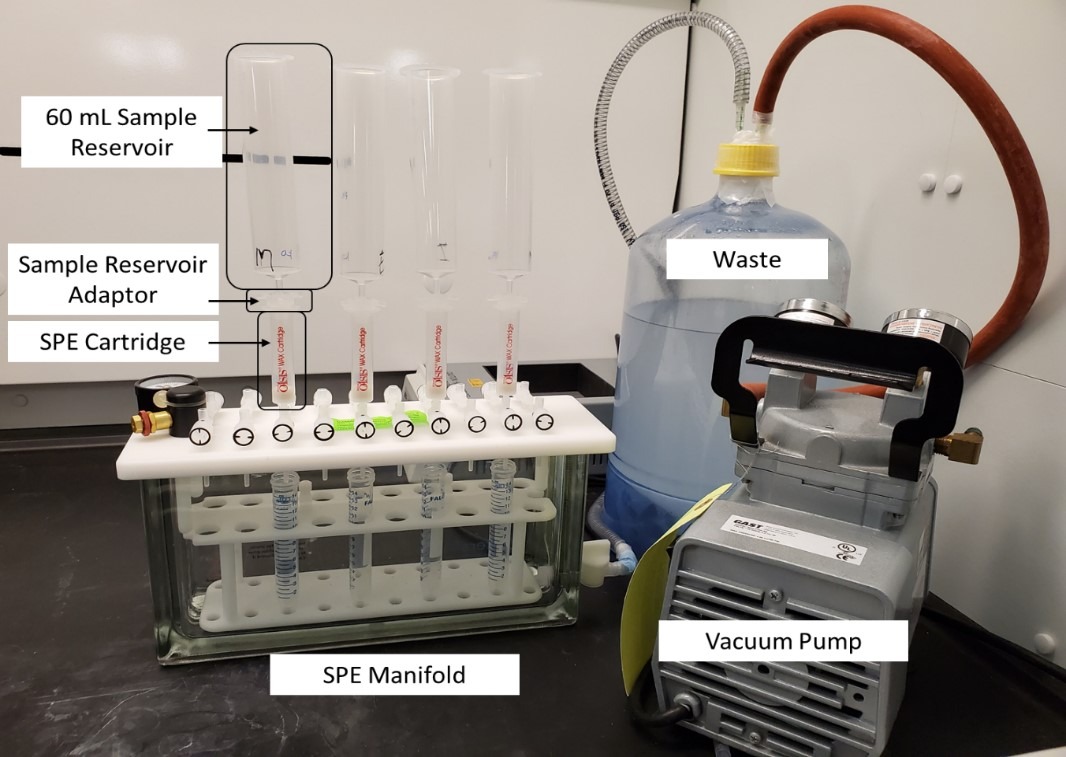
TOPIC
SPE setup for PFAS extraction
Procedure
Title: Sample Preparation Procedure for PFAS Extraction
1. Pre-Extraction Sample Preparation
1.1 Spike all collected samples with surrogates before extraction.
1.2 Add 10 µL of Wellington mix EPA-537SS-R1 to each sample to achieve a concentration of 40-160 ng/mL.
1.3 Refer to the accompanying Excel workbook (Page 1) for calculations or adjustments.
1.4 Weigh the full bottle on a balance and record its mass.
2. Conditioning the SPE Cartridges
2.1 Use Sep-Pak SP2 SPE cartridges for extraction.
2.2 Condition each cartridge with 15 mL of methanol.
2.3 Condition each cartridge with 18 mL of reagent water.
3. Sample Loading
3.1 Add 2-3 mL of sample to each conditioned cartridge.
3.2 Attach a 60 mL sample reservoir to each cartridge using an adaptor.
3.3 Load the sample onto the cartridge at a flow rate of 10-15 mL per minute.
4. Sample Rinsing
4.1 After the sample has been pulled through the cartridge, rinse the sample bottle with 7.5 mL of reagent water.
4.2 Add the rinse to the reservoir, ensuring the reservoir sides are rinsed.
4.3 Repeat this step so a total of 15 mL of reagent water is used to wash the sample bottles and reservoirs.
5. Drying the SPE Cartridges
5.1 Apply a high vacuum (approximately 10 psi) to the SPE cartridges for about 5 minutes to dry them.
6. Sample Elution
6.1 Place a rack with sample collection vials into the manifold to collect eluted samples.
6.2 Rinse the sample bottle with 4 mL of methanol and add it to the reservoir, ensuring the reservoir sides are rinsed.
6.3 Repeat this step so a total of 8 mL of methanol is used to elute the sample.
7. Sample Concentration and Reconstitution
7.1 Use a nitrogen evaporator to concentrate the samples to dryness using a gentle nitrogen stream at a maximum temperature of 60-65°C.
7.2 Reconstitute each sample by adding 1 mL of a 96:4 methanol:water solution.
8. Internal Standard Addition
8.1 Spike each sample with 10 µL of Wellington mix EPA-537IS.
8.2 Ensure the internal standards are at a concentration of 10-40 ng/mL.
8.3 Refer to the accompanying Excel file (Page 2) for calculations or adjustments.
9. Final Sample Transfer and Documentation
9.1 Transfer the prepared sample to a polypropylene vial for analysis.
9.2 Weigh the empty bottle on a balance and record its mass.
Note: An example SPE setup for PFAS extraction is provided in the accompanying documentation.
- Use the following graphic to write a DITA task topic structure content on how to set Voicemail?
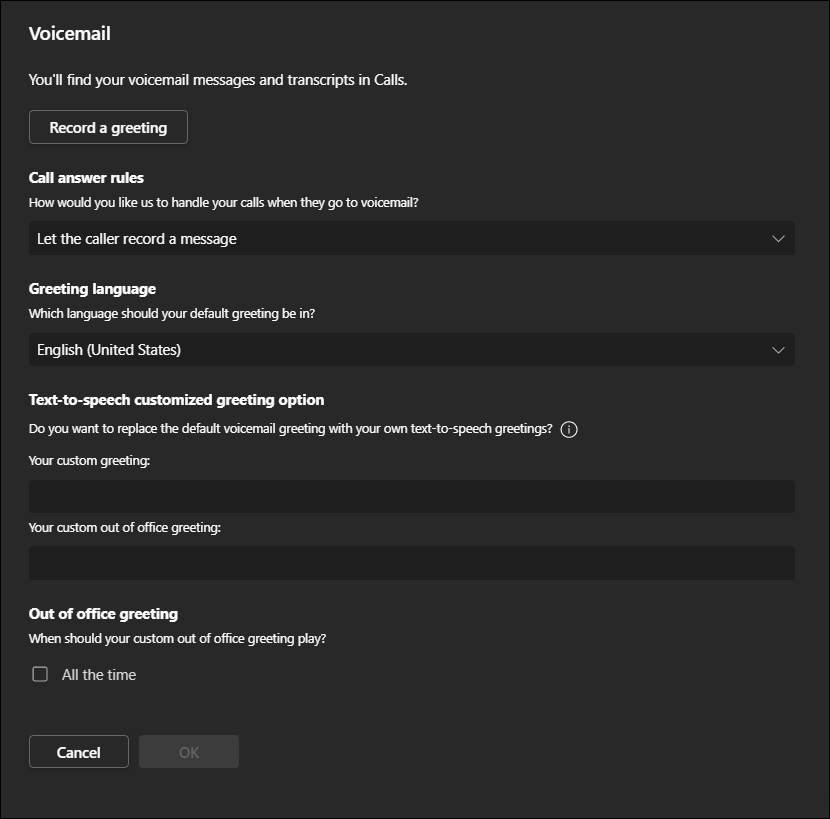
<?xml version=”1.0″ encoding=”UTF-8″?>
<!DOCTYPE task PUBLIC “-//OASIS//DTD DITA Task//EN” “task.dtd”>
<task id=”set_voicemail”>
<title>Set Up Voicemail</title>
<taskbody>
<context>
This task describes how to set up voicemail on your phone system.
</context>
<prereq>
Ensure you have a phone with voicemail service enabled and know your default PIN (if applicable).
</prereq>
<steps>
<step>
<cmd>Dial the voicemail access number provided by your service provider.</cmd>
</step>
<step>
<cmd>Enter your default PIN when prompted.</cmd>
</step>
<step>
<cmd>Follow the voice prompts to create a new PIN.</cmd>
</step>
<step>
<cmd>Record your personal voicemail greeting.</cmd>
</step>
<step>
<cmd>Save the settings and confirm your voicemail setup.</cmd>
</step>
</steps>
<result>
Your voicemail is now set up and ready to receive messages.
</result>
<example>
For example, if your service provider is XYZ Telecom, dial *86, enter the default PIN 1234, and follow the prompts.
</example>
</taskbody></task>